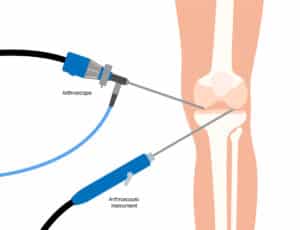
Arthroscopic knee surgery is a minimally invasive alternative to traditional knee replacement, using small incisions and a camera (arthroscope) to guide the procedure with greater precision.
Smaller incisions result in less trauma to surrounding muscles, tissues, and ligaments compared to traditional knee surgery, which involves larger incisions and more tissue disruption.
Patients experience faster recovery times and can often return to normal activities sooner due to the reduced impact on the body.
There is typically less postoperative pain, swelling, and scarring, along with a lower risk of complications like infection or blood clots.
Arthroscopic surgery can lead to better long-term joint function, though it may not be suitable for very complex cases that require more extensive access to the knee joint.
Chronic knee pain can impact your ability to perform daily activities and prevent you from living an active lifestyle. If minimally invasive, nonsurgical treatments aren’t able to provide the relief you need, knee replacement surgery may be the best solution to help you restore a pain free life.
For a long time, traditional knee replacement was the go-to technique used to replace a damaged knee joint with an artificial knee implant. This is a major surgical procedure that requires a large incision so that your knee surgeon can properly visualize the surgical area and move aside muscles and tissues to access the joint directly. Because it is major surgery, it also requires a longer recovery time.
Fortunately, advances in medical technology now make it possible to undergo knee replacement using a minimally invasive technique that allows for reduced pain and a shorter recovery time. This technique, called arthroscopic knee replacement, is often the preferred approach recommended by our knee surgeon, Dr. Kevin Borchard.
What Is Arthroscopic Knee Surgery
Arthroscopic knee surgery is a minimally invasive alternative to traditional knee replacement. It uses a series of small incisions that allow a tiny camera, called an arthroscope, to be inserted into the knee region to better visualize the damaged joint that needs to be replaced. The use of an arthroscope allows for greater precision while minimizing the impact on the surrounding muscles and tissues.
The camera on the arthroscope will transmit real-time images of your knee joint onto a screen, making it possible for your knee surgeon to replace the damaged portions of your knee joint with greater accuracy and improving the surgical outcome.
Differences Between Arthroscopic Knee Surgery and Traditional Knee Replacement
There are several key differences between arthroscopic and traditional knee replacement procedures. These include:
Incision Size – Arthroscopic knee replacement uses smaller incisions than traditional knee replacement surgery.
Tissue Impact – The smaller incisions in arthroscopic knee replacement cause less trauma to surrounding muscles, tissues, tendons and ligaments. In contrast, the larger incisions used in traditional knee replacement result in more extensive disruption to the surrounding tissue.
Surgical Precision – The use of an arthroscope provides magnified visualization of the knee joint throughout the procedure, allowing for greater levels of precision.
Applicability – While the arthroscopic technique is ideally suited for most knee replacement procedures, it may not be the best option in very complex cases involving extensive damage. In these cases, traditional surgery may provide better access to the damaged knee joint.
Benefits of Arthroscopic Knee Surgery
Due to the minimally invasive nature of arthroscopic knee surgery, it offers several important benefits compared with traditional knee replacement:
Faster Recovery Time – Since smaller incisions are used and less surrounding tissue is disrupted, patients who undergo arthroscopic knee surgery will typically heal more quickly. This allows you to start your postsurgical physical therapy sooner, resulting in a faster overall recovery time. In most instances, you may be able to resume normal activities faster with arthroscopic knee replacement.
Reduced Pain and Swelling – The minimally invasive nature of arthroscopic knee surgery results in less pain and swelling than occurs after traditional knee replacement.
Reduced Risk of Complications – While there are risks associated with any surgical procedure, arthroscopic knee surgery typically results in fewer complications than traditional knee replacement. Smaller incisions reduce the risk of infection, and there’s a lower risk of blood clots compared with more invasive procedures.
Improved Long-Term Outcomes – Arthroscopic knee replacement often produces better long-term outcomes that allow you to maintain improved joint function and mobility for many years following your surgery.
Less Scarring – The smaller incisions used in arthroscopic knee surgery result in less scarring, which may be an important consideration for many patients.
Colorado Advanced Orthopedics Can Help You Restore a Pain Free Life
At Colorado Advanced Orthopedics, we’re committed to delivering the exceptional care you deserve. Our team of board-certified, fellowship trained orthopedic surgeons can help you restore a pain free life that gets you back to enjoying your favorite activities as soon as possible.
Contact us today to schedule an appointment. CAO serves patients in Meeker, the White River Valley, Grand Junction and throughout the Western Slope.
Learn More About Knee Replacement Surgery
If you’re considering knee replacement, it’s important to understand what to expect from your surgery. We encourage you to read the following blog posts to learn more:
How Long Does Knee Replacement Surgery Take – Read a detailed overview of the surgical times for different types of knee replacement procedures, what is involved in knee replacement, and what to expect during your surgery.
How Long Does Knee Replacement Last – Knee implants will last a long time, but eventually they will need to be replaced. See the data demonstrating why you should expect your knee implant to last at least 10-15 years, if not longer, and learn the factors impacting the longevity of your knee replacement.
Monthly Orthopedic Newsletter
Subscribe to our monthly newsletter for the latest tips and insights on orthopedic health, wellness, and recovery. Discover how to celebrate life to the fullest!
 ☰ Menu